Making the t-shirts

23/05/2011 21:03 By Unknown

I decided that the easiest, quickest and cheapest way would be for me to use transfer paper to make my t-shirts.


I'm actually quite surprised at the results, I'm really happy with the way the t-shirts look, and they look like a collection too. 
Over the next couple of days I'm going to do some test shots with one of my models so that I can choose a location. In the spring bank holiday I plan to take all of my shoots with the models wearing my t-shirts, this is a great time to get hold of my models as one of them go to school and so she will be free all week. 

Mock-ups

17/05/2011 16:20 By Unknown , In

I've made mock-ups of the t-shirts in Adobe Photoshop and a mock-up of my exhibition. By doing this I can visualise my work better and I know whether or not it is how I want it to look.

I think that this would be a good way of using the space I will be given for the exhibition, and it also cuts down the cost of things such as mannequins, large prints, large photo-frames. 


I think that the t-shirts will turn out the way I want them to, I just want them to be simple as I do not have the time, money or materials to create 'fancier' t-shirts. My project is about what the t-shirts say and how the relate to women, as flowers need to be beautiful to attract insects to pollinate them - to survive, and women seem to feel as though they need to be beautiful to attract males and also to do well in life, and so I think the simplistic approach will work well. 

Exhibition

16/05/2011 22:03 By Unknown , In

I had another idea for my exhibition, I was struggling with affording everything I needed and so I decided to get my photographs printed smaller and framed, so that they fit on one wall, and on the other, make hooks to hang the t-shirts on to match against the photographs. This means that I do not have to find or buy mannequins to show my t-shirts on, and I don't need to find A2 sized photo-frames, which are expensive.
I now need to figure out what the right size would be for my photographs and frames.

Mind maps

14/05/2011 18:51 By Unknown , In ,

I have started creating mind maps to help me make decisions on the designs of the t-shirts -


 Photoshoot - 
I have decided to choose to take the photographs of my models with a plain background, there are too many problems arising for me if I do a studio shoot or a location shoot and so I have looked at Gillian Wearings 'Signs...' piece for inspiration 
(http://t1.gstatic.com/images?q=tbn:ANd9GcQFgQwDQ9sMztZSSAQ2FaMAhegnnqxH3ycPtZyxTnyNejIVyJM9pw)
(http://t2.gstatic.com/images?q=tbn:ANd9GcTm5nGVngx8tcqam6mcYuhhgL0ypvszuhTz0XlJYB9lVnfgr4Y9)
Her photographs are taken to concentrate on the message and I want mine to be the same, I don't want the background to create distractions. I also like the way her photographs looked in an exhibition and I have to think about how I want my work to look too.

 Exhibition - 
I want to print my final photographs large and frame them, to create the feel of a gallery and my sketchbook will be on a plinth in the center, as it can be read to show the journey of my FMP and how I got to the final images being shown.


Photographs

18:38 By Unknown , In

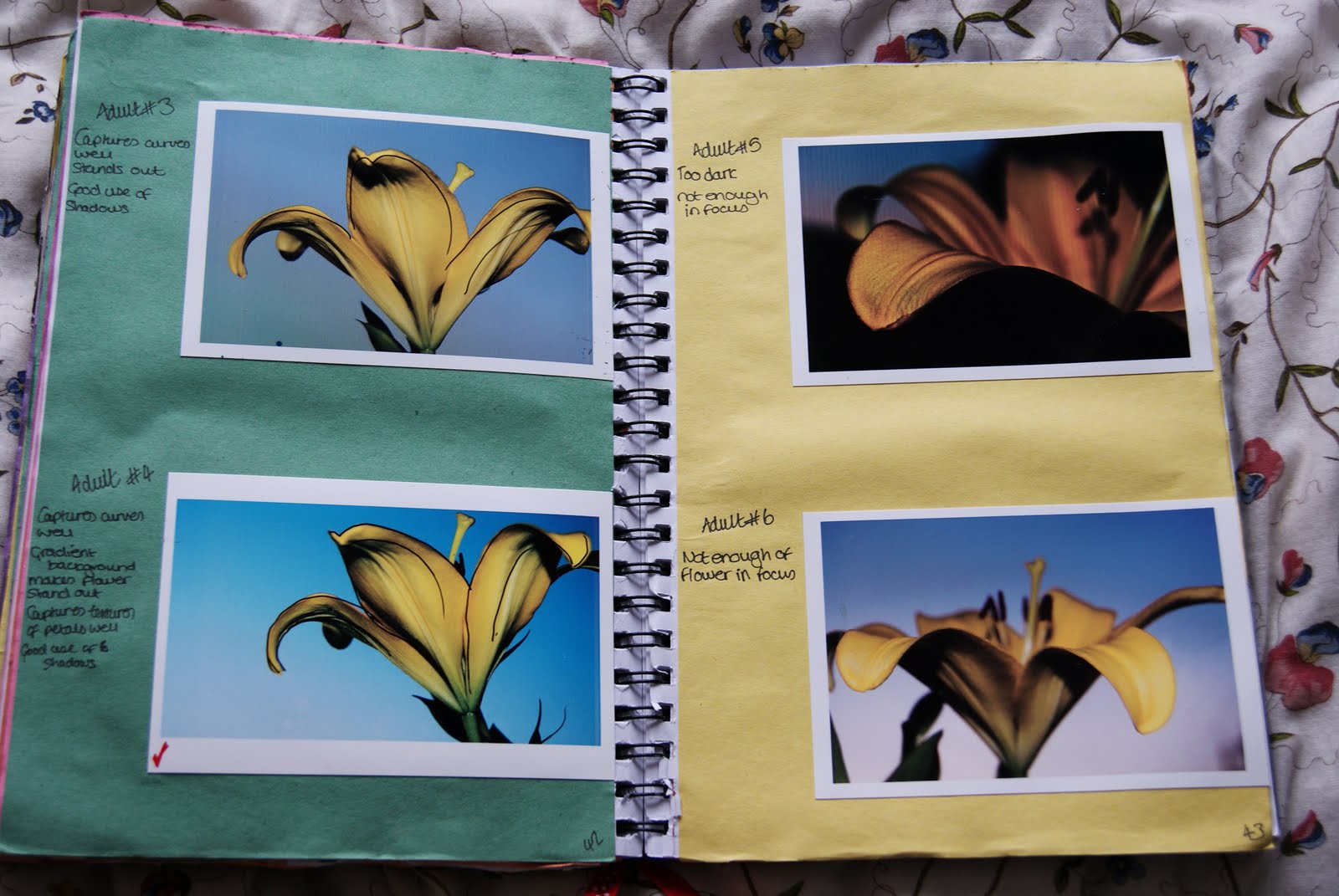
I have been taking the photographs of lilies at different stages for my t-shirts this week, I have photographed them in many places, such as against a white wall - lit from different angles to create shadows, and in front of a window to show the texture of the petals.

I decided to print all of the photographs after editing them, and I stuck them in my sketchbook to help me decide which ones I wanted to use.


I wrote about the reasons the photographs were good/bad/suitable and decided that the 'Old' and 'Teen' ones weren't suitable and that the backgrounds needed to match and so I decided to wait for clear blue skies again. After waiting for a few days and having nothing but heavy rain I decided to buy some light blue card and use that as my background. I then used Adobe Photoshop to edit them.

I didn't like the texture of the background I was getting with the card and so I took some more, I then realised that I could just change the whole background in Adobe Photoshop to look like the photographs I was already happy with.

Adult

Young

Old choice #1

Old choice #1

Teen 

These are now my final photographs and I am really happy with the way they've turned out, they now look like a collection as they have the same backgrounds and are photographed in the same ways. I just need to choose the photograph I will use for the 'Old' flower, I think I will choose the 2nd one as it's closer and so you can see more of the detail in the petals. 
All of the photographs were taken whilst I thought about capturing the femininity of the flowers, by capturing the curves and forming shadows. 

08/05/2011 16:58 By Unknown , In ,

I have researched Nick Knight as he has photographed flowers and women, as well as being a fashion photographer. I noticed that in a few of his photographs, the clothes were captured to look like flowers. I think that from looking at his work, I can take the way he captures flowers into consideration when I am taking photographs. Especially in the photograph of a dying rose, the way he has captured it becomes interesting and no less beautiful than a living rose. I can definitely take his techniques of using shadows into consideration. 
I also researched Marc Quinn after having a tutorial with my tutor, a lot of his work is to do with the way things grow, such as a human embryo, and his own had.
I also found out:
Love Bomb was specially commissioned for Jupiter Artland. The 12-metre-high orchid is the largest work from the series of sculptures, 'Garden' (2000), a walkthrough installation that brought together thousands of flowers frozen 'forever' in an impossibly perfect botanical situation.
These series meditate on the human obsession with beauty, and the tragic fact that it is impossible to maintain - a subject, which has long plagued and inspired artists to create something which transcends the flesh to aspire to the eternal. In Love Bomb the most modern technologies are used to create a modified flower at once monstrous and seductively beautiful to demonstrate the ways in which human desires are now shaping the natural world.
http://www.jupiterartland.org/the_works/the_artists/marc_quinn/
From looking at Marc Quinn’s work I can see that he has made links between humans and flowers, more in the way that humans have a desire for flowers, and also the way humans and flowers grow. His work has really interested me, especially in the ways he has documented the way humans grow. I think that he takes risks with his work and they tend to work out for him. I think that I can make a link with my work and Quinn’s in Love Bomb as he concentrates on the human obsession with beauty, and through my work I am looking at the beauty of women and flowers. His work excites me and inspires me.

Imogen Cunningham

07/05/2011 16:37 By Unknown , In

" My interest in photography has something to do with the aesthetic, and that there should be a little beauty in everything. "

Even though her first love was portraiture, Imogen Cunningham is most known for her stunning and sensual close-ups of flowers.

Her work in the 1920s contrasts with her earlier pictorialist photographs. Her childhood fascination with the beauty and complexities of nature led her to photograph all kinds of plant life, from simple flower arrangements to elaborate compositions of exotic ferns, magnolias and lilies.

Her floral studies were influenced by stark lines and were mainly of close-ups, as she believed the "paradox of expansion via reduction becomes vivid when one looks at the visual aspect of nature", 
each level of detail is echoed in the next lager and smaller level of scale.

Stylistically, she empowered her image by isolating her vegetation. What would be lost in a mass is curiously fresh and clear in solitary study. As a result "negative space became as critical to the composition as the design elements", in fact she paralleled the objectivity of the German modernists, her close-up, sensual photographs of house plants, flowers, leaves and pods often resemble animals, birds, fish and human forms.


I have researched Imogen Cunningham’s work before for photography projects, and I decided to research her again as I wondered whether I would find anything new about her. I have discovered that she made links between the human form and flowers, which links in with my own work. Looking through her photographs, I can try and use her techniques of using close-up shots to represent the human form as hers often did.